Americans for Medical Progress Statement on Research Animal Adoptions and Retirements
August 3, 2022
On occasion, news events generate public questions about the retirement or adoption of animals previously involved in biomedical research that advances both human and veterinary medicine. Below is a statement from Americans for Medical Progress to provide important information and context.
In most cases, animals involved in biomedical research must be humanely euthanized to obtain critical data being sought to improve human and animal health. However, when this is not necessary, Americans for Medical Progress fully supports the retirement and adoption of research animals, whenever possible. In fact, many scientific organizations in the United States have already established their own adoption/retirement policies and procedures to ensure their animals are well cared for after studies are completed.
Wayne State University Scientist Awarded ACNP-AMP BRAD Fellowship to Educate the Public About the Role of Animals in Brain and Behavior Research
August 3, 2022
Lana Ruvolo Grasser, Ph.D., a research associate at Wayne State University has been awarded the ACNP-AMP BRAD Fellowship. The fellowship is a partnership between the American College of Neuropsychopharmacology and the health research advocacy group Americans for Medical Progress (AMP). It was created to help raise public awareness about the essential role of animals in health research, specifically for the study of brain-behavior-drug interactions and advancements in psychopharmacology, the study of medications for treating mental disorders. Fellowship winners also help promote careers in the field of neuropsychopharmacology, the study of all forms of mental illness and their treatment.
AMP Statement on the Continued Need for Animal Studies in Dogs in Light of Highly Publicized Canine Breeding Facility Closure
July 21, 2022
News coverage of the closure of a Virginia facility that breeds dogs for human and veterinary health research has prompted numerous questions from the public. Many Americans want to know why research in canines takes place, how often these studies occur and why there are no alternatives. Below is a statement from Americans for Medical Progress in response to some of the most commonly asked questions.
Studies in dogs frequently help ensure new medications developed for human and animal use are safe and do not pose serious health risks. We simply must be as certain as possible that the medicines we ingest or provide to our loved ones will not cause harm. But research in dogs is far from the first step in this incredibly important process. These tests typically begin in cell cultures and in computer models. Once these non-animal assessments are completed and initial safety indications are met, tests in rodents then take place. Barring any problems in these small animal models, an assessment in a larger animal species comes next. When this step is finally reached, dogs are often required because canines provide highly meaningful data that has been clearly shown to translate to human health use.
Americans for Medical Progress Statement on Monkeypox Outbreak
June 1, 2022
Infectious disease outbreaks are serious public health issues. Therefore, at-risk individuals should be informed of all disease outbreaks. This applies to the seasonal flu and also unique, new disease challenges, such as COVID-19. In every case, two critical factors should always be weighed by the public: the seriousness of the disease for those who become infected and the transmissibility risk. Monkeypox can and has caused serious disease in previous outbreaks, such as a small cluster of cases in Wisconsin in 2003. However, it does not spread anywhere as easily as other infectious diseases. This is why vaccination and quarantine have been highly effective in controlling past outbreaks. We firmly believe it’s highly likely the current cases that have arisen in the United States can also be resolved using these same tested tools.
Federal Judge Orders Injunction to Protect University of Washington Committee Members Following Home Harassment, Other Threatening Incidents
May 17, 2022
A federal judge sided with members of a University of Washington research committee seeking to protect themselves and their families from escalating harassment by animal rights activists. U.S. District Judge Richard A. Jones granted a motion for preliminary injunction which prevents the University of Washington from releasing personal information requested by animal activists. If released, the details could be used to intimidate or threaten committee members.
Members of University Research Committee Jointly File Lawsuit Against University of Washington
February 24, 2022
Five members of a University of Washington committee responsible for reviewing all animal-based research proposals have filed a lawsuit against the university seeking to protect themselves, their families and their colleagues from escalating hostility and harassment from activists who oppose animal research.
Members of University Research Committee Jointly File Lawsuit Against University of Washington
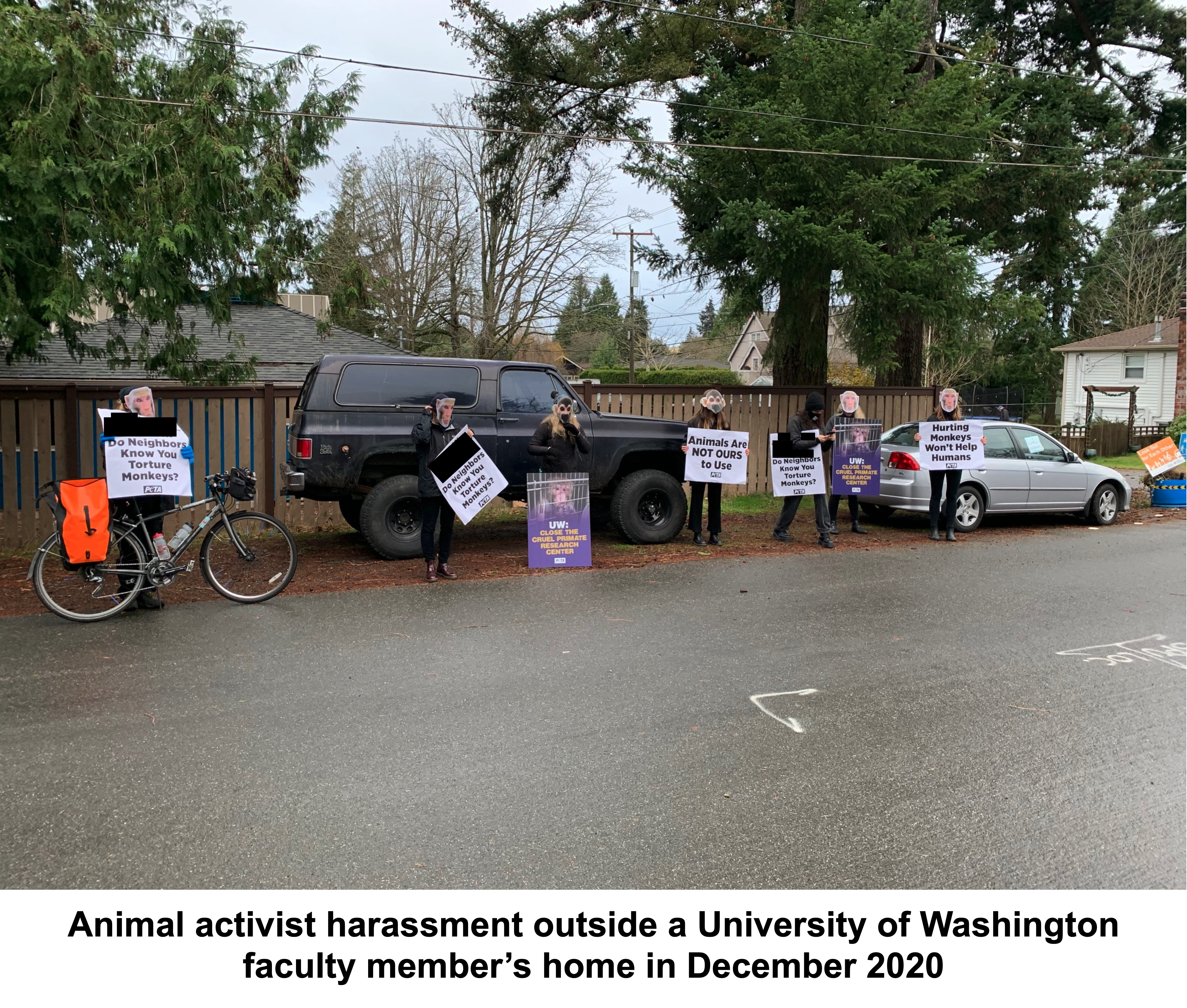 Seattle, WA – Five members of a University of Washington committee responsible for reviewing all animal-based research proposals have filed a federal lawsuit against the university seeking to protect themselves, their families and their colleagues from escalating hostility and harassment from activists who oppose animal research.
The five Institutional Animal Care and Use Committee (IACUC) members are asking the courts to block attempts by People for the Ethical Treatment of Animals to obtain their identities and also the names of more than 70 of their fellow colleagues who either currently serve or have served on the University of Washington IACUC committee.
This request comes in the wake of several troubling incidents highlighted in court filings. These include:
- The recent harassment of a University of Washington faculty member at home by a group of protestors. The gathering was organized by People for the Ethical Treatment of Animals, the same group that is now requesting the names of additional University of Washington IACUC members as well as alternate and previous committee members.
- Several threatening emails, letters and voice messages to university staff that have, among other things, referred to health researchers who work with animals as “vile [expletive] humans” adding “I’m going to do what is necessary to stop animal research.”
- A series of hostile/menacing comments recently made by members of the public attending UW IACUC meetings during the COVID-19 pandemic via Zoom. During these meetings, University of Washington labs have been likened to “Auschwitz”, and members of the university IACUC have been compared to “Nazis” and deemed “sadistic”. Note: Individual committee member names are not displayed during these meetings for personal safety and security reasons.
Americans for Medical Progress Statement on Pennsylvania Truck Accident Involving Monkeys Being Transported for Health Research
January 26, 2022
Last weekend’s truck crash in Pennsylvania, which sadly resulted in the deaths of three research monkeys, continues to receive widespread media attention across the United States and beyond. Following Friday’s accident, questions, concerns and even conspiracy theories have begun circulating.
Because this unfortunate incident continues to raise questions and generate news coverage, Americans for Medical Progress, a nonprofit organization which supports the advancement of human and animal medicine through responsible and highly regulated research in animals, wishes to provide some helpful information and context. Below is a statement from our organization.
Excerpt..
“Our organization has consulted with veterinary experts. In doing so, we have learned that while monkeys can carry a small number of naturally occurring diseases, the risks in this case were likely very minimal. Only a handful of people approached the animals. Nobody appears to have been bitten or scratched. Furthermore, stories that a member of the public became ill after the accident are apparently untrue. As the motorist in question explained to a local reporter: “I want people to know that I’m not sick despite what they read in the media.” She is wisely following the advice of federal health experts and is receiving preventative treatment as a precautionary measure.”
Americans for Medical Progress Honors the Animals Behind the COVID-19 Vaccines and Treatments
November 10, 2021
Americans for Medical Progress, a nonprofit organization that supports the advancement of human and animal medicine through responsible and highly-regulated animal research, has released a series of posters to recognize the unsung heroes behind the COVID-19 vaccines and treatments.
According to a recently released statistical analysis, coronavirus vaccination is estimated to have saved approximately 140,000 American lives between the time the vaccines were initially made available for use and May 9, 2021.
“The COVID-19 vaccines are perhaps the biggest medical breakthroughs of our lifetimes. However, despite the huge impact that coronavirus has had on all of us, many Americans are likely not fully aware of how these vaccines came to be,” said Paula Clifford, Executive Director of Americans for Medical Progress. “That’s why we decided to release a series of posters to highlight the critical role of animal studies in making these lifesaving interventions available.”
Q&A on Recent Claims Surrounding Federally-Funded Infectious Disease Research in Dogs
In recent days, several politically charged news stories and social media posts have surfaced in regards to infectious disease research conducted in dogs. Sadly, in many instances, incorrect, incomplete and/or misleading information is being circulated, leading to significant public confusion. Americans for Medical Progress has constructed the following Q&A in order to provide accurate answers to some of the most common questions that have been raised.
What is this all about?
Recent news stories and social media posts have focused on a small collection of studies to combat two separate tropical diseases. Each of these serious diseases threaten both human and animal health. One disease that is being studied is called leishmaniasis. The other is called lymphatic filariasis.
What is leishmaniasis?
Leishmaniasis is caused by a microscopic parasite named Leishmania infantum. Symptoms for infected patients might include skin sores, fever and the swelling of internal organs. In severe cases, the condition can be fatal. According to the Centers for Disease Control and Prevention, leishmaniasis infections can be found in approximately 90 countries throughout the tropics, subtropics and southern Europe. In Northern Africa, where the disease is commonly found, leishmaniasis mainly impacts children under the age of five. Leishmaniasis also poses a threat to U.S. troops and other personnel, as well as U.S. military dogs, living in areas where the disease is endemic.
Leishmaniasis is spread by sand flies which serve as the vector (or mode of transportation) for the Leishmania infantum parasite. Domesticated dogs often serve as a natural reservoir for the disease, meaning that human infections can occur when the parasite is passed from infected dogs to humans via sand fly bites.
What is lymphatic filariasis?
The second disease referenced in recent news stories and social media posts is lymphatic filariasis (LF), also known as elephantiasis.
Like leishmaniasis, LF is also caused by a parasite transmitted by insects. In this case, the parasite is spread by mosquitos. It is a dangerous, worm-like organism that can cause disease in both humans and dogs. It is the second leading cause of human disability in impacted countries. Those who are disfigured are frequently unable to work because of their disability.
Can these diseases be prevented with vaccines?
No approved vaccine currently exists to prevent leishmaniasis or lymphatic filariasis infections. However, efforts to develop vaccines to protect both humans and dogs are underway. A brief summary of some of this research can be found below.
Why must dogs be studied for leishmaniasis research?
Dogs are involved in leishmaniasis research because they are a natural reservoir for the disease. The parasite also threatens the health of dogs. The Leishmania infantum parasite often spreads when a sand fly first bites an infected dog followed by a human. The presence of parasite-infected dogs allows the disease to persist and infect additional humans and animals.
Why must dogs be studied for lymphatic filariasis research?
As mentioned previously, the parasite behind LF can cause serious disease in both humans and dogs. As a result, both species benefit from animal-based studies.
What is the purpose of the research mentioned in news stories and social media posts?
Recent news stories and social media posts focus on a combination of three research projects attempting to combat both leishmaniasis and lymphatic filariasis. Two of these studies were supported by the National Institute of Allergy and Infectious Diseases (NIAID), part of the National Institutes of Health. However, the third was not.
In one study – leishmaniasis research that has incorrectly been attributed to the National Institute of Allergy and Infectious Diseases – scientists were seeking to better understand how the Leishmania infantum bacteria is transmitted between dogs and humans. This information can now be used to develop strategies to prevent parasitic infections in both humans and animals, better control the disease in impacted species, prevent disease-related disabilities and save lives.
A second study – which was financially supported by the NIAID – is assisting in the development of a leishmaniasis vaccine aimed at preventing disease in both dogs and humans. In this NIAID-study, twelve dogs were immunized with an experimental vaccine at the Pasteur Institute of Tunis. The dogs were then let out in an enclosed open space during the day, during sand fly season in an area of Tunisia where canine leishmaniasis can be commonly found. The goal of the research was to determine if the experimental vaccine prevented the dogs from becoming infected in a natural setting. Because leishmaniasis is commonly transmitted from dogs to humans and because the disease threatens the health of dogs, canines were logically necessary for this research aimed at reducing the spread of this serious disease. At the same time, the project was designed to ensure the involved animals experienced no discomfort.
The third research project is aimed at combating lymphatic filariasis. That study took place at the University of Georgia and it was also supported by the NIAID. This research focuses on a vaccine candidate which could potentially be used to prevent lymphatic filariasis in humans, as well as other parasitic infections, including heartworm, in dogs. Because lymphatic filariasis infections pose serious risks to both humans and dogs, studies in canines are both logical and necessary.
Did the National Institute of Allergy and Infectious Diseases fund the research shown in images being distributed by news outlets and social media posts
No. The images of beagles in several news stories and social media posts were taken from an article published by the medical journal PLOS Neglected Tropical Diseases in July 2021. However, the manuscript mistakenly stated that financial support for the research had been provided by the National Institutes of Health. Neither the NIAID nor any other institute within the NIH supported this specific research project.
Here’s a link to a correction posted by the journal. A screenshot of the statement can be found below.

Question: Do dogs involved in research frequently have their vocal cords removed?
A vocal cordectomy, also known as debarking or bark softening, is occasionally performed on dogs living in either a home or research setting. It is a surgical procedure, performed by a veterinarian on an anesthetized animal, where tissue is removed from the vocal cords to permanently reduce the volume of its vocalizations. The surgery does not hurt the animals. In research settings, it may be used where numerous dogs are present. This procedure is done to reduce noise, which is not only stressful to the animals but can also reach decibel levels that exceed OSHA allowable limits for people and can lead to hearing loss.
Question: When it comes to animal research in the United States, are there any regulations or policies in place to ensure the animals are well cared for?
There are extensive regulations and measures in place in the United States to ensure the ethical treatment of animals involved in health research. These include, but are not limited to: a large collection of animal welfare laws known as the Animal Welfare Act, USDA oversight via unannounced inspections of research facilities, strict guidelines for federally funded research, onsite veterinary oversight and frequent accreditation requirements.
In specific regard to NIH-funded research, animals are protected by laws, regulations and policies to ensure the smallest possible number of subjects and the greatest commitment to their welfare. Institutions that receive research funds, including those located in other countries, must conduct animal-involved studies in accordance with the Public Health Service Policy on the Humane Care and Use of Laboratory Animals. The proposed use of animals in research is evaluated during peer review for both contract and grant proposals and animals used in research are to be provided with appropriate anesthesia and veterinary care. The principles for what is — and is not — allowed are governed both by regulations administered by the NIH Office of Laboratory Animal Welfare and the grantee institution’s animal care and use committee (IACUC)
Sources:
- Centers for Disease Control and Prevention
- World Health Organization
- National Institute of Allergy and Infectious Diseases